

Every self-publishing author hits this moment. The files are ready, the cover looks right, and there’s a quantity box waiting for a number. Fifty feels like too few. Five hundred feels brave. And somewhere at the back of your mind is a relative whose books are still sitting in cartons under the bed.
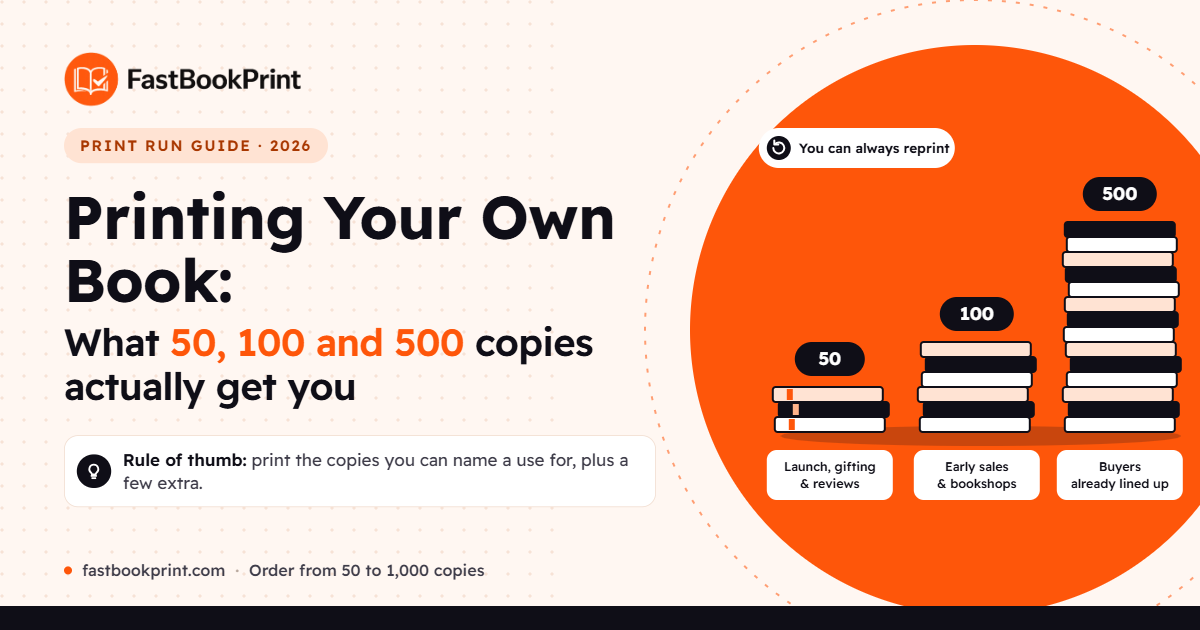
The best rule we know is this: print the number of copies you can name a use for, plus a few extra. For most first-time authors in India, that lands somewhere between 50 and 200. Fifty covers a launch, gifting and review copies. A hundred gives you room for early sales and a couple of bookshops. Five hundred makes sense when you already have the buyers lined up, such as a school order, a company, a course you teach or a long pre-order list. You can always reprint, so your first run only needs to last the next few months, not the life of the book.
50 copies
Fifty is the smallest run we print, and for plenty of first books it’s enough.
It covers family and close friends, who are usually your first and keenest readers. It covers a small launch or reading, copies for reviewers and local press, and the four copies you’re required to send to public libraries if you’re the publisher. You’ll still have a handful left to sell or keep for opportunities that turn up later.
The catch is the launch. If you’re expecting to sell copies there rather than give them away, fifty can disappear in an evening. Count your confirmed guests before you settle on it.
Fifty works well for poets, memoir writers, first-time novelists who want to test the response, and anyone who wants a properly printed book without putting in a large budget.
100 copies
A hundred gives you some breathing room. Each copy costs less than at fifty, and you’ll have enough for a launch plus a few weeks of selling afterwards.
On top of everything in the fifty-copy list, you can sell properly at the launch rather than mostly gifting. You can leave copies with two or three independent bookshops on consignment, take stock to workshops, talks or a literature festival stall, and keep a buffer for the opportunities you can’t predict yet.
Do think about storage. A hundred books fills a couple of cartons, and they need somewhere dry, especially during the monsoon.
This quantity suits authors with an audience who’ll buy in the first few months: an active social media following, a community, an alumni network or colleagues.
500 copies
Five hundred brings the price per copy down further, but it’s a real commitment of money and space.
It makes sense when the books already have somewhere to go. That could be a bulk order from a school, college, coaching institute, NGO, temple, company or association, or course material or workbooks for a programme you run again and again. It also suits authors with an audience they’ve already proven, through a blog, a YouTube channel or a newsletter, and commemorative or corporate books where every copy has a named recipient.
If most of the 500 don’t have a planned destination, the lower price per copy is a false saving. Books that don’t sell aren’t stock. They’re a cost.
The three side by side
| 50 copies | 100 copies | 500 copies | |
|---|---|---|---|
| Typical use | Launch, gifting, reviews | Launch plus early sales | Bulk orders, courses, a proven audience |
| Price per copy | Highest of the three | Lower | Lowest |
| Total spend | Lowest | Moderate | Highest |
| Storage | One or two cartons | A couple of cartons | Several cartons and proper space |
| Risk of unsold stock | Low | Low to moderate | High without confirmed demand |
Exact prices depend on your size, page count, paper, binding and print type. Use the instant quote calculator to compare 50, 100 and 500 copies of your own book.
Working out your number
This takes about five minutes. Grab a sheet of paper and fill it in honestly.
| Who gets a copy | How many |
|---|---|
| Family and close friends | |
| Legal deposit (if you’re the publisher) | 4 |
| Reviewers, press and people with an audience | |
| Launch or event sales (confirmed guests who’ll likely buy) | |
| Bookshops on consignment (number of shops × copies each) | |
| Direct sales in the first three months | |
| Confirmed bulk orders | |
| A buffer of about 10% | |
| Total |
Then round up to the nearest quantity option. If you get 70, choose 100. If you get 180, choose 200 and plan on reprinting if the book takes off.
Once you have your number, upload your PDF to see the exact price for that quantity and preview the book before you order.
What printing too many really costs
The price per copy is only part of it. Extra stock ties up money you could have spent on editing, design or promotion. It takes up space, which matters more in a smaller home or a humid city. If you spot a typo, update your bio or rework a chapter, every unsold copy still carries the old version. And sooner or later you end up discounting books just to clear the cupboard.
A smaller first run followed by a corrected reprint is often the better deal overall, even if each copy costs a bit more the first time.
When to reprint
A sensible rule: reprint when what you have left would last less than a month at your current rate of sales, or when an order comes in that you can’t fill. A reprint is also your chance to fix errors and add review quotes to the cover.
Your specifications stay saved on FastBookPrint, so you can reorder without setting everything up again. Most orders ship within 3 to 5 working days of confirmation, so order a couple of weeks before you expect to run out.
Questions authors often ask
What’s the minimum number of copies I can print? It varies between printers. With us, it’s 50 copies, and you can choose up to 1,000.
Is it worth printing only 50 copies? Yes, if you know where they’re going. Fifty covers a launch, gifting, review copies and the legal deposit for a lot of first books.
Does printing more copies make each one cheaper? Yes. The fixed setup work is shared across more copies, so the price per copy drops as the quantity goes up.
How many copies do I need for legal deposit? The publisher has to send one copy to the National Library in Kolkata and one each to three other public libraries within 30 days of publication. Plan for four.
Can I reprint later with changes? Yes. You can reorder with the same specifications, and if you’ve changed the content, just upload the updated PDFs for the new run.
How long will it take to get my books? Most orders ship within 3 to 5 working days of confirmation. Delivery within India generally takes 3 to 7 business days after dispatch.
Start with the number you’ll use
The right first run gets your book into readers’ hands without leaving cartons in the corner. Make your list, add a few extra, and keep the reprint option in your back pocket.
Compare prices for 50, 100 and 500 copies of your book, or upload your files when you’re ready to order.