
Once the book is ready, there are two broad ways to get copies made. You can print a batch and hold the stock yourself. Or you can let a platform print one copy every time somebody orders. Both work. Which one is right for you has less to do with printing than with how you plan to sell.
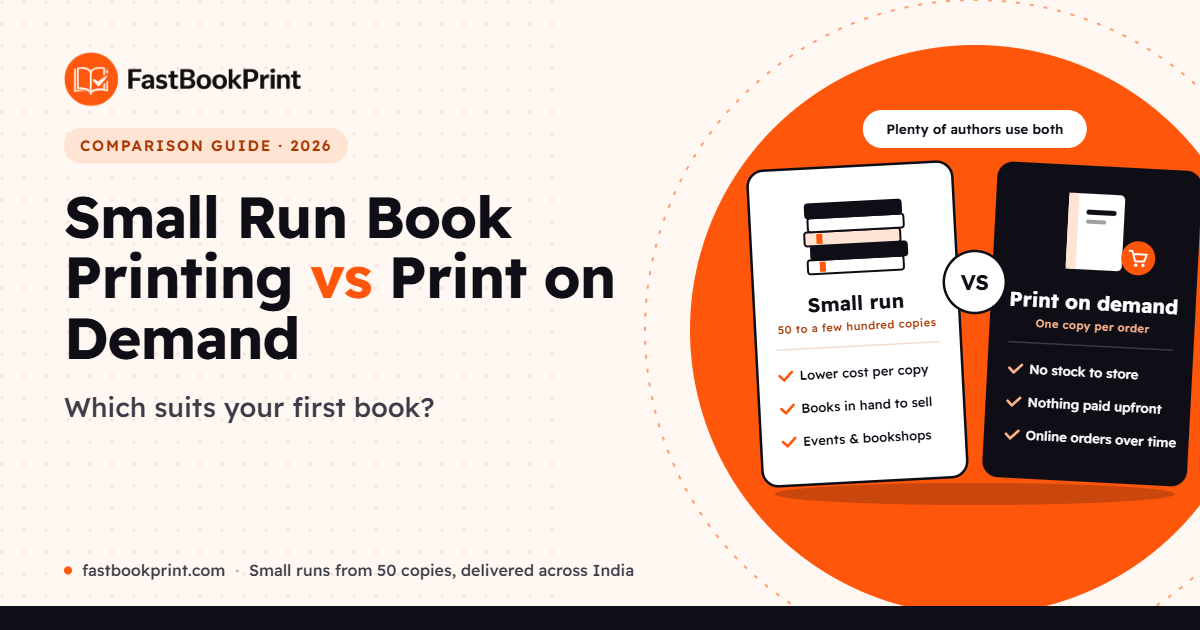
Print on demand prints a single copy only when a reader orders it, usually through an online platform. You don’t hold any stock, but each copy costs more and you have less say over the price and presentation. A small run, also called a short run, means ordering a batch of anything from 50 to a few hundred copies, which you keep and sell yourself. Each copy costs less and you have books in hand, but you pay upfront and need somewhere to store them.
As a rough guide, print on demand suits authors whose sales will mostly come from scattered online orders over time. A small run suits authors who’ll sell at events, through bookshops, to institutions or to their own network. Plenty of authors end up using both.
How print on demand works
Your files sit with a platform. When someone orders a copy, the platform prints it, ships it, and pays you whatever is left after its costs, usually as a royalty. In India, several self-publishing platforms offer this, Pothi and Notion Press among them.
The appeal is obvious. There’s no print order to pay for upfront and no stock to store, the book never goes out of print, and you never have to pack a parcel.
The trade-off is cost. Every copy is effectively a one-copy print job, so each one costs more. You’ll also have less control over the selling price and your margin, and sometimes over how the book is listed. Your choice of size, paper and finish depends on what the platform supports. And if you want your own copies for an event, you’ll often be paying the per-copy price plus shipping each time.
How a small run works
You order a batch, it’s printed in one go, and the books arrive with you. Digital printing has made runs of 50 to a few hundred copies practical. Older offset printing usually needed much larger quantities to be worth it.
Because the setup cost is shared across the whole batch, each copy works out cheaper. You have books ready for launches, signings, events and bookshops. You set the price, run your own discounts and bundles, and keep the whole margin on anything you sell directly.
In return, you pay for the run upfront, you need space for the cartons, and you handle the posting when someone orders from you online. Print too many and you’re left with unsold stock.
On FastBookPrint, small runs start at 50 copies. You upload your files, see the price immediately, preview the book and order online, with delivery anywhere in India.
Side by side
| Print on demand | Small run | |
|---|---|---|
| How copies are made | One at a time, as orders come in | In one batch you order |
| Upfront cost | Low or nothing for printing | You pay for the whole run |
| Cost per copy | Higher | Lower |
| Stock to store | None | Yes |
| Control over price and margin | Limited by the platform | Full |
| Books in hand for events | Order and wait each time | Ready immediately |
| Works best for | Readers spread across the country buying online | Events, bookshops, institutions, direct sales |
| Main risk | Lower margin | Unsold stock |
When print on demand is the better fit
Print on demand makes sense if your readers are spread around India and will mostly buy online, and you don’t have a launch, a bookshop or a community where you’ll sell in person. It’s also the safer choice when you genuinely can’t guess how many copies will sell and you’d rather not carry the risk. Niche reference books that sell a few copies a month for years are a good example.
When a small run is the better fit
A small run usually wins if you have a launch, reading, workshop, conference or literature festival coming up, or if most of your sales will come through your own network, website, classes or social media. It’s the natural choice when there’s a bulk buyer involved, such as a school, college, coaching centre, company, NGO or community group. It also makes sense if you want copies in local bookshops on consignment, or you want full control over the price for launch offers and bundles.
If that sounds like you, get an instant quote from 50 copies and compare the price per copy at different quantities.
Using both
For a lot of authors, this ends up being the most practical setup. Print a small run first for the launch, review copies, events, bookshops and the legal deposit. List the book with a print on demand service so readers who find it online later can still order it. Then reprint a small batch whenever another event or bulk order comes along.
Before you do this, read the print on demand platform’s terms carefully. Some ask for exclusivity, and some want their own ISBN on the edition they sell. If the ISBN is in your name, you have more freedom. In India it’s free from the national ISBN agency.
Five questions to ask yourself
Where will most of my readers buy: online, in person, or through an organisation? How many copies can I confidently say will be used in the next three months? Do I need books in hand by a particular date? Do I want to set the price myself? And do I have room for a few cartons?
If your answers lean towards selling in person, a fixed date and control over price, start with a small run. If they lean towards unpredictable online sales and no storage space, start with print on demand.
Questions authors often ask
Is print on demand cheaper than printing a batch? There’s no upfront cost with print on demand, but each copy usually costs more. A small run costs more at the start and less per copy.
What’s the minimum for short run book printing? It varies by printer. We print from 50 copies.
Can I sell print on demand copies at my launch? You can order copies from the platform in advance, but you’ll usually pay the per-copy price plus shipping and need to leave time for delivery. For events, a small run is usually simpler.
Do I need an ISBN for a short run? Not to print. You will need one to get the book listed with most bookshops and online marketplaces. In India, ISBNs are free from the Raja Rammohun Roy National Agency for ISBN.
How quickly can I get a small run? Most of our orders ship within 3 to 5 working days of confirmation, and delivery within India generally takes 3 to 7 business days after dispatch.
Go where your readers are
Print on demand and small runs aren’t really competing with each other. They’re different tools. Work out where your readers actually are, then pick the model that gets books to them with the least waste. If you need copies in hand for a launch, a class or a bookshop, a small run is usually the simple answer.
See your price for a small run from 50 copies, or upload your PDF to order and preview your book.